A job interview is supposed to help an employer decide whether you are a good fit for the company, but it should work both ways. Before you accept a landscaping job, you should also be trying to figure out what kind of company you are actually joining.
Is the operation organized? Do employees stick around? Does management communicate well? Are people constantly putting out fires? Does the company seem to know what it expects from the person in your role?
You probably will not get a perfect answer to every question before your first day, and no company is perfect. But if you pay attention, you can usually learn quite a bit before you accept the offer.
The goal is not to hunt for reasons to reject an employer. It is to make a more informed career decision by looking for patterns in how the company operates, communicates, and treats its people.
Pay Attention to How the Hiring Process Is Run
The hiring process is one of your first opportunities to see how the company operates. Did they know you were coming? Was the interviewer prepared? Did they understand the position? Did they follow up when they said they would?
One scheduling mistake or delayed email does not mean the company is poorly run. Landscaping businesses are busy, and unexpected problems happen. What matters more is whether there is a pattern of poor communication, missed commitments, or confusion.
If every step feels disorganized and different people are giving you different answers about the job, it is reasonable to wonder whether that same lack of organization shows up elsewhere in the business. On the other hand, a company that communicates clearly, respects your time, and keeps you informed is already showing you something about how it works.
Make Sure They Can Clearly Explain the Job
Job titles in the Green Industry can mean very different things from one company to another. A Crew Leader at one company may be focused primarily on production, while the same title somewhere else could include customer communication, paperwork, training employees, managing equipment, and helping with scheduling.
The same is true for titles like Account Manager, Production Manager, Operations Manager, Designer, Sales Representative, or Branch Manager. Before accepting the job, make sure you understand what the company is actually hiring you to do.
Ask who you will report to, what you will be responsible for, what a normal week looks like, and what the company expects you to accomplish during your first 90 days. It is also worth asking how they will measure whether you are doing a good job.
A well-run company should be able to give you reasonably clear answers. If nobody can define what success looks like, it becomes much harder for you to succeed once you are there.
Ask Why the Position Is Open
This is one of the simplest questions you can ask, and it can tell you a lot.
Maybe the company is growing. Maybe someone was promoted. Maybe it added a new division or recently won a large contract. Maybe the previous employee left, or maybe the company terminated someone because the role was not working out.
None of those answers automatically make the opportunity good or bad. What matters is whether the employer can explain the situation honestly.
An employer may not be able to share details about a former employee, but it should usually be able to explain the basic circumstances around the opening. If the position has turned over several times in a short period, it is fair to ask why.
You are looking for context, not perfection.
Find Out What Staffing Really Looks Like
Being short-staffed is common in many Green Industry companies, especially during peak season. That alone does not mean the company is poorly managed.
The more important questions are why the company is short-staffed, how long it has been short-staffed, and whether the situation is temporary or simply the normal way the company operates. A growing company may be hiring because it just added a major account or expanded into a new market. Another company may be struggling to find qualified workers in a tight local labor market.
Those situations are very different from a company that has been chronically understaffed for years because employees constantly quit.
You should also ask how the staffing situation will affect you. Does being short a few people mean occasional overtime during busy periods, or does it mean you will regularly be doing the work of two or three people? Will managers need to spend more time in the field? Will you be expected to cover multiple positions?
There is nothing wrong with stepping up when a team needs help. But you should understand what you are signing up for.
If you are being hired as a Production Manager, for example, you should know whether you will actually be managing production or spending three days a week running equipment because the company cannot keep crews staffed.
Look at the Operation, Not Just the Interview Room
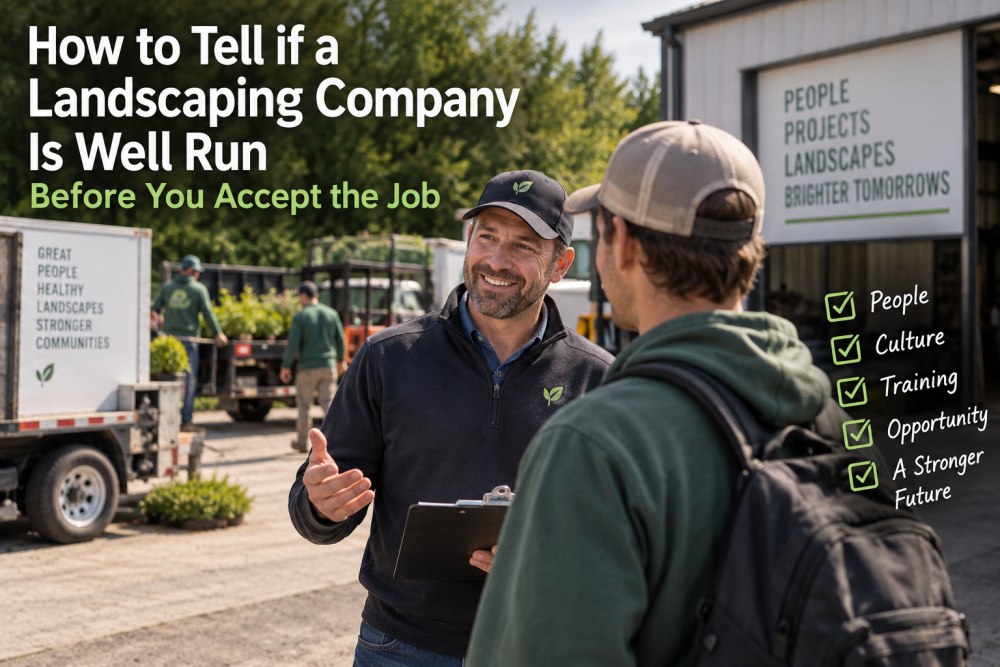
If you get the opportunity to visit the company’s shop, yard, or branch, pay attention. You can learn a lot just by looking around.
Are trucks reasonably maintained? Is equipment cared for? Are materials organized? Do employees have the safety equipment they need? Does the operation look functional, or does everything seem neglected and chaotic?
That does not mean everything should be spotless. Landscaping companies are working environments. Trucks get dirty. Equipment gets scratched. Materials pile up during busy periods. An older truck does not automatically mean you are looking at a bad employer.
The better question is whether the operation looks maintained and intentional. A company does not need the newest fleet in town, but it should look like someone is taking care of the business.
Watch How People Are Treated
Company culture is difficult to measure from a job advertisement. You often see it much more clearly in small interactions.
Pay attention to how the owner or manager speaks to employees and how employees speak to one another. Do people seem comfortable asking questions? Does leadership seem to know the people working for them? Do employees appear constantly frustrated or burned out?
It is also worth listening to how managers talk about employees who are not in the room. If every former employee is described as lazy, incompetent, or the problem, that should at least make you curious.
Strong leaders can usually talk about difficult situations without tearing people down.
Culture is not a company picnic, free lunch, or slogan painted on the wall. It shows up in how people are treated when work gets busy, a customer is upset, equipment breaks, or somebody makes a mistake.
Find Out How the Company Handles the Realities of Landscaping
Green Industry businesses deal with uncertainty every day. Weather changes. Equipment breaks. Customers make last-minute requests. Jobs take longer than expected. Crews call off. Materials do not arrive.
None of those things mean the company is poorly run. The real question is how the company handles them.
Ask how employees receive their schedules and how far ahead they normally know where they will be working. How are rain days handled? What happens when the schedule changes? Who does a crew leader call when a problem develops in the field? If snow work is part of the position, what is expected during winter storms?
A good operation will still have surprises. The difference is that people usually know how to respond when the surprises happen.
Understand the Hours, Seasonality, and Overtime
Do not stop at asking whether the position is full-time. Ask what full-time actually looks like throughout the year.
The answer may be very different in April than it is in January. Some people want as much overtime as they can get. Others care more about having predictable hours. Neither preference is wrong, but you need to understand the reality before you take the job.
Ask about typical weekly hours during peak season, overtime expectations, weekend work, snow and ice responsibilities, rain days, winter schedules, seasonal layoffs, and whether employees truly work year-round.
A vague answer like, “We usually stay pretty busy,” does not tell you much. Ask for specifics.
Look at Employee Tenure and Advancement
One of the better indicators of a company’s work environment is whether people stay.
Ask how long the managers have been there. Are there Crew Leaders or Account Managers who have worked for the company for several years? Did any managers start in field positions? Can the company give you examples of people who have advanced internally?
High turnover deserves questions, but it does not automatically mean a company is bad. Some landscaping positions naturally experience more turnover than others, and seasonal work, entry-level positions, and competitive labor markets can all contribute.
The more useful question is whether the company understands why people leave. A well-run company should have some idea where its retention problems are and what it is doing to improve them.
The same applies to career advancement. Almost every job advertisement says there are “opportunities for growth.” Ask for examples. If employees really do grow with the company, there should be people who have already done it.
Ask How People Are Trained
Training can tell you a lot about how seriously a company takes its employees.
What does onboarding look like? Who trains new employees? How does someone learn the company’s equipment, systems, and procedures? How does a new Crew Leader learn what is expected? How does a manager learn the company’s financial or operational systems?
Even experienced Green Industry professionals need time to learn how a new company does things.
Another useful question is what happens when someone makes a mistake. Everybody eventually makes one. A broken irrigation line, damaged plant material, missed customer request, estimating error, or equipment problem will happen sooner or later.
The way the company responds tells you something. Good companies hold people accountable, but they also coach, correct, and improve systems so the same problem is less likely to happen again.
There is a difference between accountability and creating an environment where everyone is afraid to make a decision.
Get Clear About Compensation and Benefits
You should understand how you will be paid before accepting an offer. That sounds obvious, but compensation can become surprisingly unclear when bonuses, commissions, overtime, vehicles, or seasonal schedules are involved.
Make sure you understand the basics of the offer, including:
- Base wage or salary
- Overtime eligibility
- Bonus or commission structure
- Health insurance
- Retirement benefits
- Paid time off
- Vehicle or vehicle allowance
- Phone reimbursement
- Any other benefits that matter to you
If compensation includes a bonus or commission, ask how it works. What triggers the payout? How is it calculated? When is it paid? Is the formula written down?
You should not have to guess what your compensation package means.
Senior-Level Candidates Should Look at the Business Itself
If you are interviewing for a management, sales, operations, or executive-level position, go one step further and try to understand how leadership thinks about the business.
Where is the company trying to grow? What types of customers or projects does it want more of? What are its biggest operational challenges? What is leadership trying to improve over the next year? What would your role be responsible for changing?
You do not need access to confidential financial information during an initial interview. But if you are accepting responsibility for a major part of the business, leadership should be able to explain where the company is going and why your position matters.
Use Online Reviews Carefully
Employee reviews on sites like Indeed and Glassdoor can be useful. So can Google reviews, social media, and other information you find online.
Just do not treat them as the final verdict.
A single angry former employee can write a brutal review. A company can also have a handful of glowing reviews that do not reflect the experience of most employees.
Look for patterns instead. If several people independently mention the same problem over a period of time, it may be worth asking about.
You can even bring it up professionally during the interview. A strong employer should not be afraid of a reasonable question.
Do Not Confuse Appearance With Quality
A big company is not automatically better run than a small one. A family-owned landscaping company with 25 employees may have excellent systems, experienced leadership, strong financial controls, and employees who have worked there for decades.
A much larger company can still be disorganized.
Do not judge the company only by the size of the building, age of the trucks, or how impressive the website looks. Look deeper. You are trying to understand the operating habits behind the business.
Questions Worth Asking Before You Accept
You do not need to walk into an interview with a fifty-question checklist. A few good questions can tell you a lot.
Consider asking:
- Why is this position open?
- What happened to the last person who held the role?
- What would make someone successful in this position?
- What would you expect me to accomplish during my first 90 days?
- Are you currently short-staffed? If so, why?
- How would the current staffing situation affect this position?
- How long have the people on this team typically been with the company?
- Can you give me an example of someone who has advanced within the company?
- What are your busiest and slowest times of year?
- What is one thing the company is actively trying to improve right now?
You may not ask every one of these in every interview. Choose the ones that matter most to your situation.
More about what you should really be trying to learn during an interview.
Look for Patterns, Not Perfection
Every landscaping company has problems. Every company has had a bad hire, experienced employee turnover, dealt with equipment breakdowns, managed a difficult customer, or had a week when the schedule fell apart.
The question is not whether problems exist. The question is how the company responds to them.
Does leadership acknowledge problems? Do they communicate honestly? Do they learn from mistakes? Do employees know what is expected of them? Does the company appear to have systems for managing the normal challenges of the business?
Those are much better indicators of what it may be like to work there.
Before you accept your next Green Industry job, take some time to look beyond the offer itself. Ask good questions, pay attention to what you see, and make sure you understand the company you are joining—not just the job you are being offered.